
What is a recruitment agency in India for overseas hiring?
A recruitment agency in India for overseas is a company that India has registered to recruit Indian workers for employers in other countries. It works for the employer under a Power of Attorney, and it answers to the Indian government for each worker it sends.
What Indian law requires
India controls overseas recruitment through the Emigration Act, 1983. The Ministry of External Affairs (MEA) runs the system, and three parts of it matter to an employer.
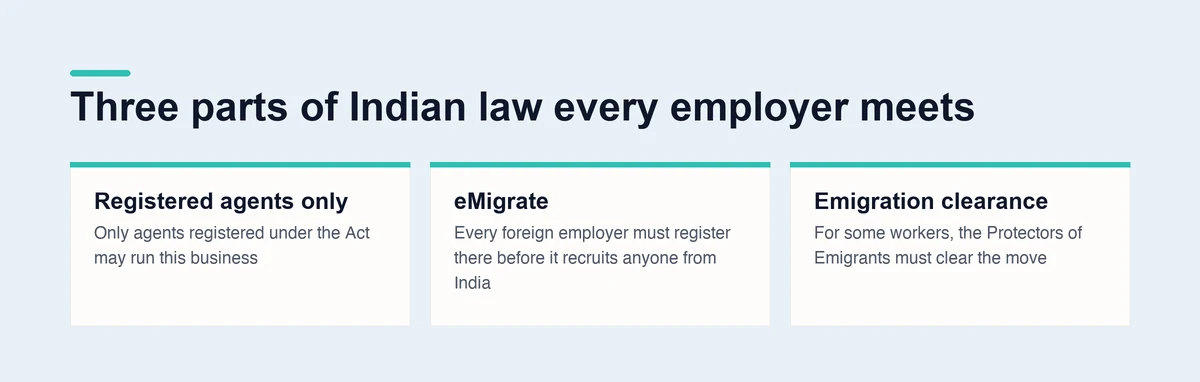
- Registered agents only. Under Section 10 of the Act, a person who recruits Indian citizens for jobs abroad must first register with India's Protector General of Emigrants. The MEA says only agents registered under the Act may run this business.
- eMigrate. eMigrate is the government portal where employers, agents and workers file every overseas hire. The MEA says every foreign employer must register there before it recruits anyone from India.
- Emigration clearance. For some workers, the Protectors of Emigrants must clear the move before the worker can leave India. They follow the procedure that the Act sets out.
There are two ways to hire. You can recruit directly through eMigrate, or you can name a registered Recruiting Agent in your demand. This guide follows the agent route, because most employers use an agent to find and screen workers.
A registered agent also gives you a check on the other side. The agent makes sworn promises to the government about each worker, so the government can act against an agent that breaks the rules.
Who needs emigration clearance
Indian passports come in two kinds for this purpose. An ECR passport means "Emigration Check Required". An ECNR passport means no check is required.
- ECR passport holders need emigration clearance before they take a job in one of India's ECR countries. The list covers the Gulf states, Malaysia, Thailand and others. Check the current list on the MEA website, because older MEA pages give different versions of it.
- ECNR passport holders do not need emigration clearance. For work in an ECR country, their eMigrate registration is voluntary at present.
- Libya and Yemen are on the ECR list, but India has stopped emigration clearance for both for now.
In practice, many blue-collar workers hold ECR passports. If you hire for a Gulf construction site, plan for clearance on most of your workers.
Hiring from India, step by step
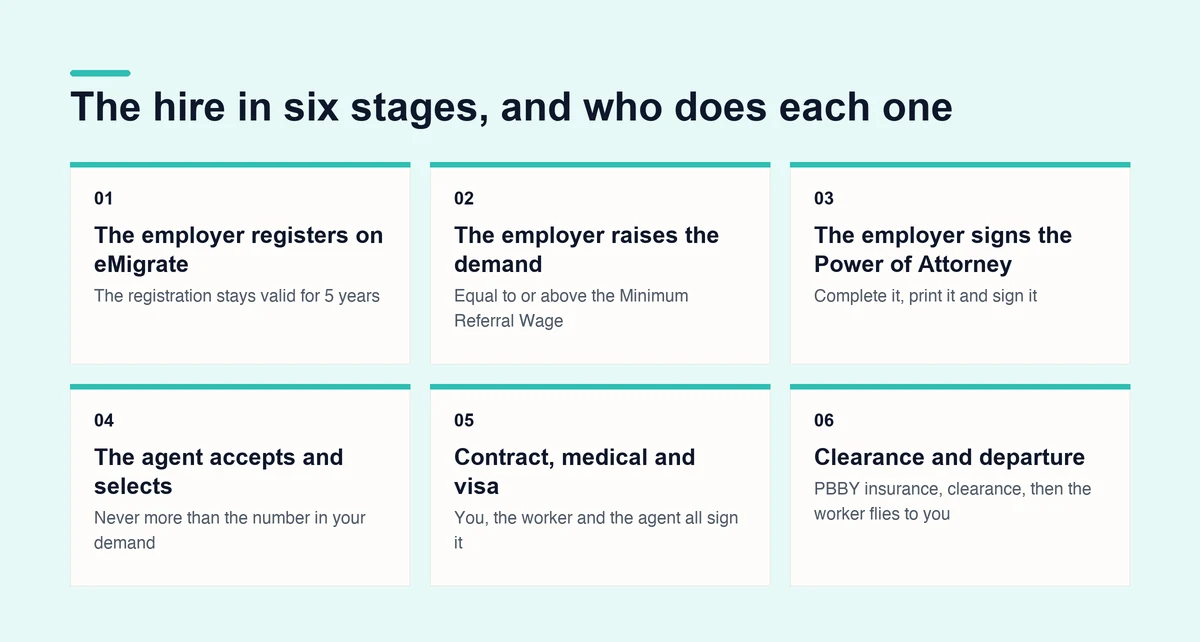
Each step below names who does it. The steps follow the official eMigrate manuals for employers and for agents.
- 1
The employer registers on eMigrate
You create an eMigrate account and upload a request letter that the Indian Mission in your country has signed. The registration stays valid for 5 years.
- 2
The employer raises the demand
In eMigrate you open Services, then Raise Demand. You list the jobs and choose an agent instead of direct recruitment. The salary for each job must be equal to or above the Minimum Referral Wage for that job and country.
- 3
The employer signs the Power of Attorney
eMigrate gives you two documents: a Power of Attorney and a Demand Acknowledgement. You complete the Power of Attorney, print it and sign it.
- 4
The agent accepts the demand
The agent checks the demand letter details in eMigrate and uploads your signed Power of Attorney. The agent can accept your vacancies, but never more than the number in your demand.
- 5
The agent selects the workers
The agent sources candidates in India, screens them and arranges the interviews you want.
- 6
The employer issues the contract
You create the employment contract on eMigrate. You, the worker and the agent all sign it. The worker's emigrant registration cannot go ahead without a signed copy.
- 7
Medical and visa
The agent arranges a full medical check-up for every worker before travel. You arrange the visa or work permit in your country.
- 8
Clearance and departure
The agent files the clearance for ECR workers. The worker buys the compulsory Pravasi Bharatiya Bima Yojana (PBBY) insurance before the clearance fee is paid. The PBBY policy covers ₹10 lakh for accidental death or permanent disability. After clearance, the worker flies to you.
Documents the employer sends
The MEA lists what the clearance file needs for a skilled or semi-skilled worker that an agent recruits. These are the papers that come from your side.
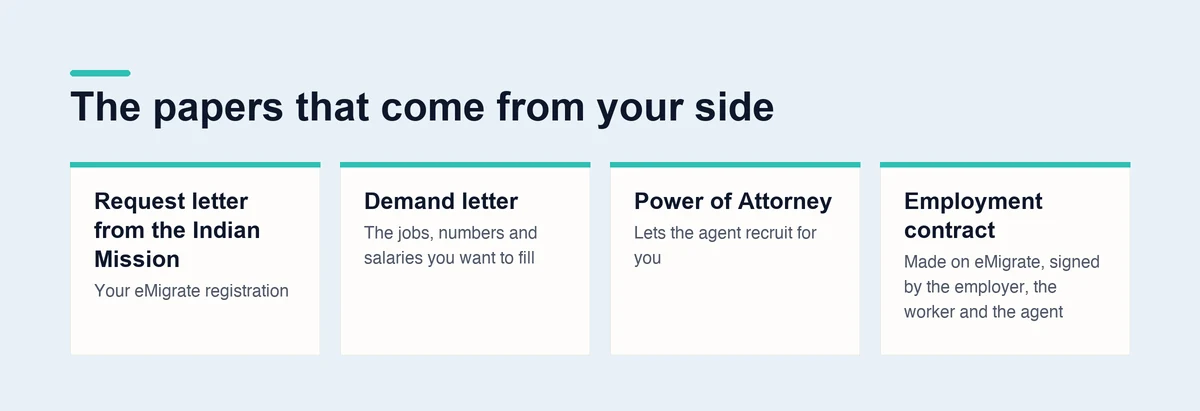
| Document | What it is for | Who signs |
|---|---|---|
| Request letter from the Indian Mission | Your eMigrate registration | The Indian Mission |
| Demand letter | The jobs, numbers and salaries you want to fill | The employer |
| Power of Attorney | Lets the agent recruit for you | The employer |
| Employment contract | The worker's terms, made on eMigrate | The employer, the worker and the agent |
| The worker's visa | Entry to your country | Your country's authorities |
The worker adds a passport with at least 6 months of validity. The agent adds the PBBY policy and the fee challan.
For unskilled workers and women workers, the rules ask for one more step. The Indian Mission must also attest every employment document in the file.
Where hiring from India goes wrong
The official manuals do not publish a list of rejection reasons. They do show where a hire can stop.
- The salary is too low. eMigrate does not accept a salary below the Minimum Referral Wage for the job and country.
- The numbers do not match. The agent cannot take more vacancies than your demand shows. If you need more workers later, raise a new demand.
- The Power of Attorney is not signed. The agent cannot accept your demand until it uploads the signed document.
- The contract is missing signatures. Without a signed contract, the worker's emigrant registration stops.
- The attestation is missing. For unskilled and women workers, papers without the Mission's attestation hold up the clearance.
The most serious problem comes after arrival. If workers complain and India finds you at fault, India can put you on its Prior Approval Category list. That list blocks you from recruiting in India in the future.
How we handle it
Concord Recruitment is a registered Recruiting Agent on eMigrate. As your recruitment agency in India for overseas hiring, Concord Recruitment accepts your demand with your Power of Attorney, finds and screens the workers, signs the contract with you and files the clearance in India. Send your requirement on our employers page.
Frequently asked questions
Can an overseas employer hire from India without an agent?
Yes. eMigrate lets you choose direct recruitment when you raise a demand. Then your company does the sourcing, screening and paperwork in India itself.
Do all Indian workers need emigration clearance?
No. Only workers with an ECR passport who go to work in an ECR country need it. Workers whose passports have no ECR stamp do not need clearance.
How long is an eMigrate employer registration valid?
An employer registration on eMigrate is valid for 5 years.
What is the Minimum Referral Wage?
The Minimum Referral Wage is the lowest salary that eMigrate accepts for a job in a given country. Your demand must offer that amount or more.
Who signs the employment contract?
The employer, the worker and the Recruiting Agent all sign it.
How do I check if a recruitment agency in India for overseas jobs is genuine?
Ask whether it is registered under the Emigration Act and listed on eMigrate. Only registered agents may recruit Indian workers for jobs abroad.
Sources
- Recruiting Agents (RAs), Ministry of External Affairs
- Overseas Employment FAQ, Ministry of External Affairs
- Protector General of Emigrants, Ministry of External Affairs
- Overview of the work of Overseas Employment, April 2026, Ministry of External Affairs
- Issues of intending emigrants, Ministry of External Affairs
- eMigrate Foreign Employer manual
- eMigrate Recruiting Agent manual
- Emigration clearance system, Ministry of External Affairs